
Related posts:
Boston bombing suspect ordered deported after Obama meets with Saudi minister http://fb.me/2sA8K9kAf
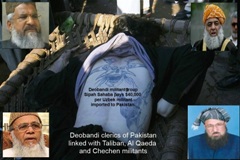
Exposed: Links between Deobandi militants of Sipah Sahaba Pakistan and Uzbek militants
It has unfortunately become clear that two Chechan Salafi-Wahabi Muslims are the prime suspects of the Boston Bomb blasts. We have been stressing the violence that emerges from this Wahabi-Salafi-Deobandi Islamofascist cult and how this violence has affected not only Western countries and other countries in Asia but also Pakistan where its victims include Shias, Sunnis (Barelvis, Moderate Deobandis), Hindus, Christains, Ahmadis, Sikhs, Pashtuns, Baloch etc.
It has also brought havoc to previously pluralist societies in Iraq, Syria, Mali, Nigeria, Somalia, Algeria, Egypt, Libya and Sudan. After 9/11 and Fort Hood Massacre by Salafi-Wahabi terrorist, this Wahabi-Deobandi terrorism has visited Boston. The epicenter of this terrorism is Saudi Arabia, Qatar and their minions. The Global community needs to stop supporting Al Qaeda and must take action before it is too late.
….
One of the suspects in the Boston Marathon bombings was killed early Friday morning after leading the police on a wild chase after the fatal shooting of a campus police officer, while the other was sought in an immense manhunt that shut down large parts of the area. Gov. Deval Patrick of Massachusetts said residents of Boston and its neighboring communities should “stay indoors, with their doors locked.”
The two suspects were identified by law enforcement officials as brothers. The surviving suspect was identified as Dzhokhar A. Tsarnaev, 19, of Cambridge, Mass., a law enforcement official said. The one who was killed was identified as his brother, Tamerlan Tsarnaev, 26. The authorities were investigating whether the dead man had a homemade bomb strapped to his body when he was killed, two law enforcement officials said.
The manhunt for the surviving suspect sent the Boston region into the grip of a security emergency: residents of the city and the surrounding area were urged to stay indoors, as hundreds of police officers conducted a manhunt and all public transit services were suspended.
Col. Tim Alben of the Massachusetts State Police said investigators believed that the two men were responsible for the death of a Massachusetts Institute of Technology police officer and the shooting of an officer with the Massachusetts Bay Transportation Authority, the region’s transit authority. “We believe these are the same individuals that were responsible for the bombing on Monday at the Boston Marathon,” he said.
Officials said that the two men were of Chechen origin.
….
Two Dagestani brothers nembers of Chechen Wahhabi cell identified as responsible for Boston terrorDEBKAfile Special Report April 19, 2013http://debka.com/article/22911/Two-Dagestani-brothers-nembers-of-Chechen-Wahhabi-cell-identified-as-responsible-for-Boston-terror
Parts of Boston, Watertown and other outlying towns were placed under curfew and public transport suspended Friday, April 19, as police huntedr one of the the Boston Marathon bombers who with his partner carried out a shooting spree at the MIT campus, during which a police officer was shot dead. After a shootout with the police, the second bomber died of his wounds having been taken into police custody. The second bomber, the one in the white cap, escaped in a SUV they snatched with a hostage, who was later released. While being chased, they threw explosives out of the window and critically injured a second police officer. Police warn that the escaped man is a terrorist, who is armed and dangerous and advise householders to stay indoors and not open the doors to strangers.DEBKAfile reported earlier:The police officer was shot dead when he responded to a disturbance caused by the appearance of two men armed with guns, explosives and wearing body armor. It is suspected they were preparing to seize a university building in a terror attack. After initial gunshots were heard at Building 32 on Vassar Street, dozens of SWAT teams, police moved toward the building, soon joined by FBI agents and a police helicopter. Gunfire and explosions were heard during the hunt for the killer indicating a gun battle in progress. One suspect is reported injured and taken to hospital under heavy guard. An MIT alert described the situation as active and extremely dangerous. One man is in custody, but it is not known whether he was involved. The situation remains unclear.The incident occurred hours after the FBI released filmed images of two suspects in the Boston Marathon bombing on Monday with a request to the public for assistance in identifying them. A possible link between the two events is being intensely investigated.DEBKAfile reported earlier:The FBI released Thursday images of two suspects filmed on the move at the site of the Boston Marathon bombings of Monday, April 15. The footage with stills has been widely distributed and an FBI Tipline set up. Public assistance in identifying the two youngish men is considered critical to the investigation.Suspect 1 is shown wearing a black cap and, walking fast close behind him, Suspect 2 in a white cap. Both carry large black packages and both have Middle East complexions.FBI Agent Richard Deslauriers who is in charge of the investigation said Suspect 1 planted the first bomb, while a few seconds later, Suspect 2 was filmed placing a package at the site of the second, more powerful bomb, and walking away very fast.Both men are dangerous, he said, and should not be approached by the publicThe images the FBI released of the two suspects have been floating around the Internet for the past 36 hours. And so the suspects must know they are being hunted. DEBKAfile’s counterterrorism sources add that both have either gone to ground in a pre-arranged hideout or have left the United States. The way they walk behind each other as they pass through crowds without losing contact strongly recalls the formation maintained by the suicide bombers who blew up the London Tube train on July 7, 2007
In the US and other Western media, removing the spotlight off of the Wahhabists (Saudi Arabia) is high priority business, thanks to the wonders of black gold flowing from Riyadh and Doha.
Ironically, USA, UK and other Western countries have been big supporters for Wahhabi-Deobandi Islamists in Chechnya, Libya, Afghanistan, Syria through their fanatic Wahhabi (Salafi) allies in Saudi Arabia. Now not unlike 9/11, Saudi-funded Wahhabis are at play once again. Saudi-funded Wahhabi terrorists from Chechnya, with known links with Saudi-funded Deobandi militants of Afghanistan and Pakistan (Taliban, Sipah Sahaba ASWJ, Al Qaeda) are responsible for the Boston bombings.
Video: Egyptian Salafi Wahhabi Cleric Murgan Salem: Boston Bombing Was Meant to Deliver a Message; Similar Attacks Expected in France
http://www.youtube.com/watch?v=JrLsz-AIuzY&feature=player_embeddedA radical Egyptian Salafi (Wahhabi) cleric said that the terror attack in Boston this week was meant to send a message to the West, that terrorists are alive and well. Not unlike Wahhabis and Deobandis of Pakistan, Afghanistan, Syria, Turkey, Libya etc, Salafis of Egypt too are heavily funded by Saudi Arabia and other Arab Gulf countries.
The cleric, Sheik Murgan Salem, also warned that similar attacks were expected in France. Salem made the comments during an interview on Tahrir TV on April 16, 2013. The interview was translated and posted to the internet by the Middle East Media Research Institute (MEMRI).
“Obviously, I do not know who carried out that operation, but if it was done by the mujahideen, it serves as a message to America and the West: We are still alive,” he said. “Contrary to what you say, we have not died. The [Americans] wanted to send a message to the entire world that they had finished off the mujahideen – not just the mujahideen of Al-Qaeda, but the mujahideen all over the world. I do not know who carried out this attack, but if it was indeed the mujahideen, it was meant as a clear message to America and to the West,” continued Salem, who said the terror attack “was not up to the standards of Al-Qaeda. It was extremely amateurish. The standards of Al-Qaeda are much higher.”
The cleric goes on to say that he was “like one family” with both former Al-Qaeda leader Osama bin Laden as well as current leader Ayman Al-Zawahiri.
Spread of Saudi-funded Wahabi-Deobandi ideology into Chechnya
It is crucial to understand the extent and nature of Saudi Arabia’s and other Arab countries involvement in the Chechen movement, as this has contributed significantly to changing the resistance from a nationalist movement to one tainted by religious radicalism of violent Wahhabis and Deobandis (semi-Wahhabis from Pakistan, Afghanistan and India).
The feeling that the conflict may spill over regionally and Russian theories about Islamic Wahhabi-Deobandi extremism spreading across the Caucasus have been fuelled by incidents like the threat of radicalization in Dagestan, the Chechen raid into Ingushetia in June 2004, and clashes in Kabardino-Balkaria in October 2005, where dozens were killed. Locals across the region deny these events are part of an evil foreign plot; instead they see them as an extension of the Chechen conflict and a reaction to Russian policies.
In 2003, the U.S. State Department designated three Chechen groups affiliated with Shamil Basaev as terrorist groups, and alleged that they had received millions of dollars from Al-Qaeda (a Wahhabi-Deobandi group). Thus, the Chechen resistance movement became forcefully identified with terrorism, although the same statement did not categorize all Chechens as terrorists.
Following the 1979 Soviet invasion of Afghanistan, a number of Wahhabis and Deobandis rallied to defend their fellow Muslims. Later, following the call of cleric Abdullah Azzam, transnational Islamic brigades were set up to defend frontline Muslim communities around the world. The International Islamic Brigade, which took part in the first Chechen war in 1994, was set up by Habib Abdel-Rahman Khattab Salafi (Wahhabi), a Saudi by birth. His aim was to radicalize the Chechen armed resistance and give it an extremist coloring.
As a teenager, Khattab had fought in Afghanistan alongside Osama bin Laden, under the leadership of Hussein al-Sarehi, in the battle of the Lion’s Den in 1987. Later, fighting in Tajikistan, Khattab gained a reputation as a brilliant commander, before moving to Chechnya as head of the foreign mujahideen. He was appointed military commander of operations under Basaev. Bin Laden maintained a close ideological, technological, and financial relationship with Khattab, who helped in mobilizing mujahideen in Ingushetia, Ossetia, Georgia and Azerbaijan to fight the Russians in Chechnya and Dagestan, with money provided by Al-Qaeda. Later, Khattab married a Dagestani woman and lived in Chechnya until his death at the hands of Russian intelligence in 2002.
Several hundred Chechens were trained in Al-Qaeda’s Afghan camps and armed. The Al-Qaeda-influenced Al-Ansar was considered the fiercest and most organized of the three major Chechen groups fighting the Russians. Most of the Chechen suicide attacks – previously an unknown tactic in that part of the world – were initiated by this group. European intelligence reports suggest that Al-Qaeda assisted Al-Ansar in weapons trafficking via Russian, Ukrainian and Chechen criminals.
Khattab’s influence with Basaev extended to inciting a revolt among the top Chechen commanders and creating divisions that forced President Aslan Maskhadov, who did not share Basaev’s radical vision, to implement an Islamic (Wahhabi-Deobandi) government and set up religious courts. Maskhadov’s failure to impose law and order and control radical commanders, however, led to his loss of credibility in Moscow. His assassination in March 2005 at the hands of Russian intelligence was hailed as a victory by the federal government. In reality, it squandered a chance to pursue a political process in Chechnya with a key Chechen leader who had considerable influence among his people.
The exact number of foreign Islamic Wahhabi-Deobandi mercenaries fighting in Chechnya is unknown, but up to 300 Arabs reportedly took part in the war, according to Russian intelligence sources. The growth of this group’s power in Chechnya played a key role in precipitating the second Chechen war following an armed incursion into Dagestan in 1999. This jeopardized all possible peaceful solutions for Chechnya’s independence. Isolated, the Chechens tapped into the resources offered by Islamic organizations and networks in the Middle East and Asia. Warlords realized the benefits of forging alliances with radical groups, especially with respect to funding, training, recruiting and international contacts and support.
Moscow legitimately interpreted conflict or opposition as an Islamic Wahhabi-Deobandi threat, and blamed external actors for indigenous problems.
With 20 million Muslims in Russia, Putin attempted to play the Muslim card when he addressed the OIC summit in Kuala Lumpur in October 2003. Moscow also sought to reverse perceptions in the Islamic world that it was pursuing anti-Islamic policies, especially in the North Caucasus.
Russia’s repeated accusations that Saudi Arabia was funding Chechen militants and was the main source for imported radical ideologies were somewhat toned down following Crown Prince Abdullah’s visit to Russia in September 2003. Putin lauded the Saudi role in the war against terrorism and contending that both countries shared similar concerns on terrorism. The Saudi advice was that a solution to the Chechen conflict be sought through constitutional means, within the framework of a federal Russia. The Saudis also stressed that this was a domestic issue for Russia, an indication of the lack of Saudi government involvement in the conflict.
The assassination, by Russian agents, of Zelimkhan Yandarbiyev in Doha in February 2004, strained Qatari-Russia relations. Doha had repeatedly turned down Moscow’s requests to extradite Yandarbiyev on terror charges. Besides being implicated in the Moscow theater takeover, he was the link to those in the Gulf financing Chechen militants. Following the assassination, the Russian Embassy’s first secretary in Doha was expelled and two Russian intelligence agents linked to the assassination were put on trial, further intensifying the row. The issue was put to rest only after an understanding was reached between Russian and Qatari leaders, whereby the accused were returned to Moscow.
The international community has a responsibility to address the spread of Wahhabi-Deobandi violent ideology of Jihadism from Chechnya to Libya and from Syria to Afghanistan.
Read more: http://www.dailystar.com.lb/Opinion/Commentary/Mar/13/Arabs-and-Islam-in-the-Chechen-war.ashx#ixzz2Quc1cZoo(The Daily Star :: Lebanon News :: http://www.dailystar.com.lb)
Saudi Arabia sponsors violent Wahhabi-Deobandi groups in Pakistan and other countries
Saudi Arabia, the cradle and citadel of Wahabism, was the main financial backer of the Wahabi-Deobandi organisations of Pakistan. It financed their activities in Pakistan to purify Islam and their participation in the war in Afghanistan. Not only the Saudi intelligence services, but also indiv



